Showing posts with label seeds. Show all posts
Showing posts with label seeds. Show all posts
Wednesday, July 11, 2012


Monday, March 19, 2012
Saving - Keeping your seeds
As some of you know I'm a Heirloom seed gardener. I don't plant hybrid seeds but only open-pollinated seeds, seeds that come true to type and can be saved. Over the years I have been saving more and more seeds of my plants. At first it was just the easy ones like lettuce and tomatoes, peppers anything that won't cross pollinate as bad and didn't need any special pollination care like isolation boxes or are a lot of work to process since I really didn't have any real seed screens instead using my kitchen sieves.
Now I save so many seeds every year, of so many varieties I really need to keep good track of what seed is in which seed bag.....I was getting to many little plastic baggies with 'unknown' variety or '???' written on them, because either the writing with the permanent marker had rubbed off or I forgot to label them right away, thinking I would remember which variety it was and then didn't.
So last year I sat down with my Print-Shop software and designed a seed pack that would fit into a 3" x 5" plastic bag.

I added the name of the plant variety and very basic grow info on the design and added a picture of the vegetable plant. They were some nice seed packs but it took too much time to cut and glue them together every time I needed some. It ended up being a way bigger job then I wanted it to be.
I ended up just using the front side, cutting away the rest, since I was storing the seed envelopes in plastic bags anyway, I really didn't need all the paper. So this spring I decided to redesign the whole thing and came up with paper card inserts that perfectly fit into the plastic baggies and since a bit larger also were able to hold much more growing info.

I can also add many more inserts on one sheet of paper.......saving paper and trees. Also just having all the important growing info right in front of me when I need it, is just so nice, plus instead of cutting paper and gluing I get to have more fun planting and playing in my garden.
Now I save so many seeds every year, of so many varieties I really need to keep good track of what seed is in which seed bag.....I was getting to many little plastic baggies with 'unknown' variety or '???' written on them, because either the writing with the permanent marker had rubbed off or I forgot to label them right away, thinking I would remember which variety it was and then didn't.
So last year I sat down with my Print-Shop software and designed a seed pack that would fit into a 3" x 5" plastic bag.
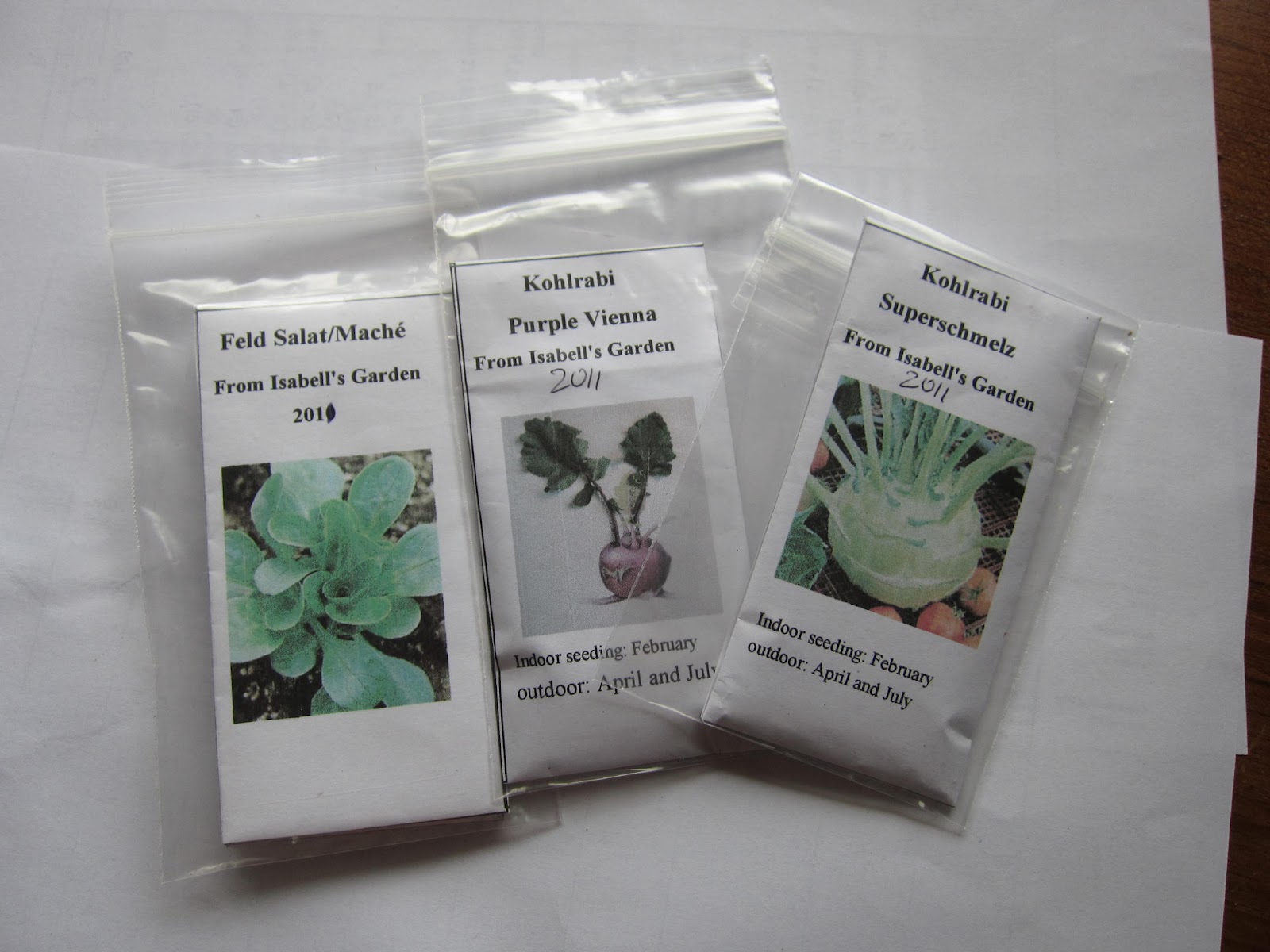
I added the name of the plant variety and very basic grow info on the design and added a picture of the vegetable plant. They were some nice seed packs but it took too much time to cut and glue them together every time I needed some. It ended up being a way bigger job then I wanted it to be.
I ended up just using the front side, cutting away the rest, since I was storing the seed envelopes in plastic bags anyway, I really didn't need all the paper. So this spring I decided to redesign the whole thing and came up with paper card inserts that perfectly fit into the plastic baggies and since a bit larger also were able to hold much more growing info.
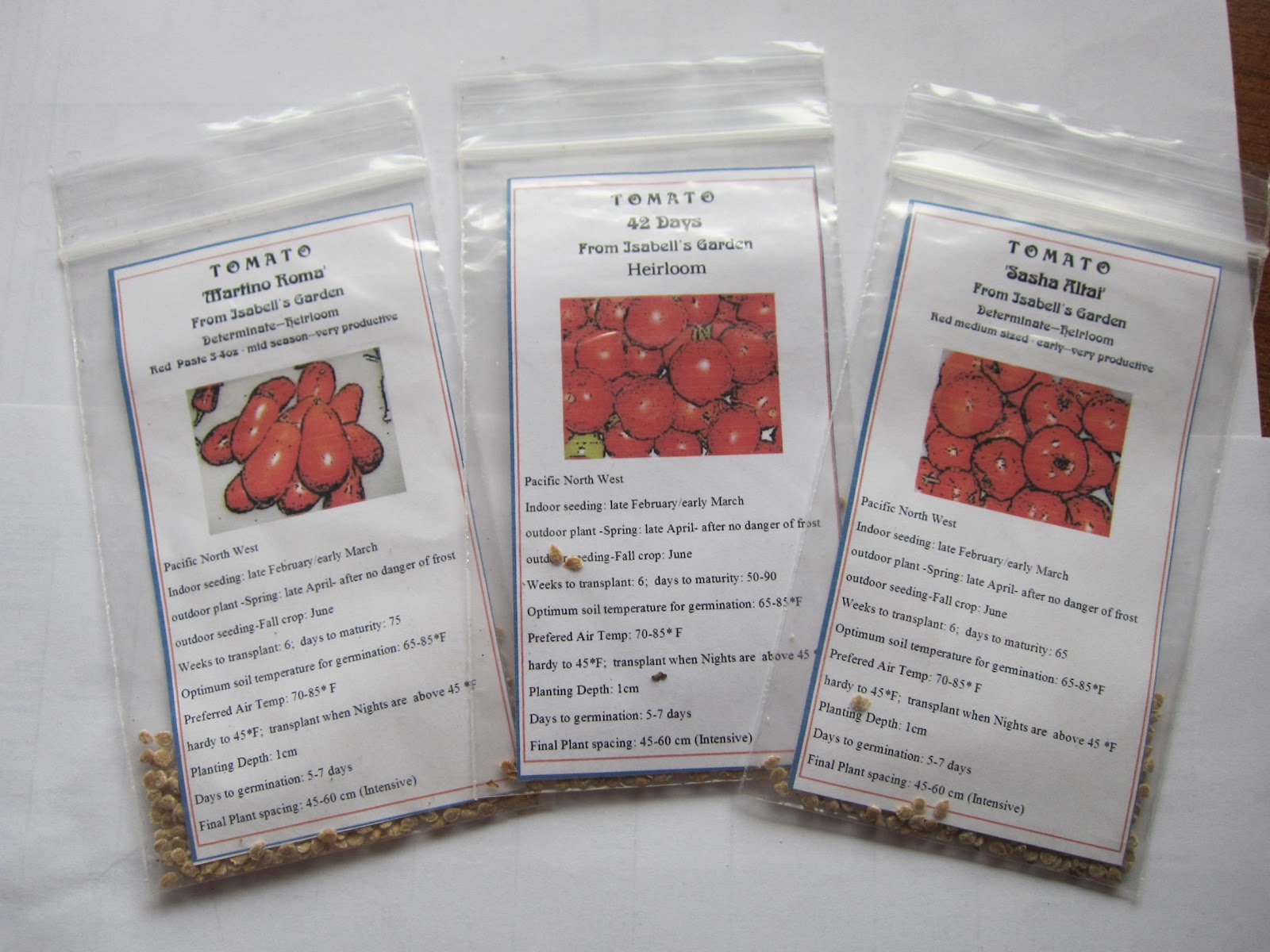
I can also add many more inserts on one sheet of paper.......saving paper and trees. Also just having all the important growing info right in front of me when I need it, is just so nice, plus instead of cutting paper and gluing I get to have more fun planting and playing in my garden.
Tuesday, October 6, 2009
Saving Seeds of Peas
Peas because they are big seeds and are contained in a pod, so don't scatter are easy to collect. They also belong to the self pollinating group, so come usually true to seed. There is a slight possibility that insect activity could produce a bit of cross pollination, however regular peas should not cross with sugar peas and vice versa. It's been never a problem for me but to prevent any crossing you can keep different varieties five to ten feet apart. Or, if you don't have the space, you could just plant only one variety of each kind each year and still be able to keep your seeds going there pea seed are viable for 3 years, if kept at cool, dry conditions.
Pea vines can become a tangled mess, which can make identification of individual plants difficult. It helps to keep the single plant just a bit apart for easy identification, or better plant a few pea plants separate from the ones you plan on eating just for seed production. To get a pound of seeds it will take about 15 feet of peas planted in a row, planted at the proper spacing, or the equivalent of that planted in a shorter but wider area. Peas need zinc to form peas in the pods so if you see not many pea seeds forming you might have zinc deficiency which can be corrected with adding Zinc-Sulfate to your soil.
Before you can shell the seeds for keeping, they need to thoroughly dry in the pod. Take them out to early they will rot. To make sure they are all completely dry it's a good idea to dry the vines in a well-aired area for a week or more, making sure you don't pack them to tight together so they don't become damp and rot. Damp seeds won't have good growing qualities. After they are dry you can hand crack the pods or thresh the seeds.
Store in good sealed containers or bags in a cool, dry environment or you can store them in the freezer, which should make them stay viable for at least five years. Before you plant them, you need to take them out of the freezer to defrost and warm up.
Pea vines can become a tangled mess, which can make identification of individual plants difficult. It helps to keep the single plant just a bit apart for easy identification, or better plant a few pea plants separate from the ones you plan on eating just for seed production. To get a pound of seeds it will take about 15 feet of peas planted in a row, planted at the proper spacing, or the equivalent of that planted in a shorter but wider area. Peas need zinc to form peas in the pods so if you see not many pea seeds forming you might have zinc deficiency which can be corrected with adding Zinc-Sulfate to your soil.
Before you can shell the seeds for keeping, they need to thoroughly dry in the pod. Take them out to early they will rot. To make sure they are all completely dry it's a good idea to dry the vines in a well-aired area for a week or more, making sure you don't pack them to tight together so they don't become damp and rot. Damp seeds won't have good growing qualities. After they are dry you can hand crack the pods or thresh the seeds.
Store in good sealed containers or bags in a cool, dry environment or you can store them in the freezer, which should make them stay viable for at least five years. Before you plant them, you need to take them out of the freezer to defrost and warm up.
Monday, September 28, 2009
Saving Seeds-The Easy Ones
To get seeds, the pollen has to be the correct kind, and it needs to get to the ovule at the right time of the plants vegetative growth to reproduce itself. Only the pollen of the related species will result in seeds. Seeds from a cabbage will not pollinate your tomato, since they are different species. Even within the same species, some plants won't get pollinated by their own pollen, even though they cross-pollinate easy within their plant family. Cabbage plants are a good example of this. To get good cabbage seeds, you need at least two of the same variety, better would be more, all flowering at the same time. But you need to keep them from being pollinated by another plant of the cabbage family, like Broccoli for example.
Some plants are easier to save seeds from then others. Some plants pollinate themselves, this means they accept their own pollen, from their own flowers either with or without insects.
This means for the gardener, you don't necessary need a whole bunch of the same plants to get viable seeds, although it's always better to save seeds from several plants of the same kind; this also means they cross pollinate rarely with each other and the seed will result in plants which look just like the parent plant because the inheritance is the same.
You do have to make sure, that you don't have a Hybrid plant, hybrids unfortunately will not result into a plant which looks like it's parent.
Plants which fall into this category of 'Self Pollinating' plants are:
Barely, Lima Beans, Snap Beans, Cow Peas, English Garden Peas, Endive, Lettuce, Corn Salad, Oats, Soy Beans, Tomatoes and Wheat.
Being self pollinating makes them the best choice for the 'Beginner Seed Saver'. These are the plants you should start with.
In fact, many of those are so easy to grow, if you don't want to bother with picking the seeds, you could just let them bolt to seed and if your climate allows, let them seed themselves. I have been doing this with my lettuce and corn salad for years, I find sometimes the seeds sprout easier this way, then if I seed them by hand. Over the years I introduced a new lettuce variety each year, I now easily get 10 different lettuce varieties, all seeded by themselves. I just dig up as many seedlings as I want and move them to the proper location. I also always have plenty seedlings to give away to my friends or neighbors. I still collect seeds of the plants anyway, to be able to start the lettuce in the off, hot season, when it won't start itself outside, but growing lettuce this way gives me a very early spring crop. The plants know when the weather is just right to sprout. It never failed for me.
When should the seeds get collected?
This all depends on which seed you want to collect. Some seeds, can be collected before they are completely mature and dry, get dried off the plant and they will grow fine this way. Other seeds won't sprout if you collect them immature.
Seeds of Lettuce, Spinach, Tomatoes, Snap Beans, Corn Salad and Radishes will grow alright, even if you collect them immature. Seeds of Peppers, Carrots, Celery, Peas don't germinate so well if you collect them before they are ripe.
That said, it still is always better to let the seeds ripen fully, you just get a better germination rate that way.
Since Lettuce is one of the easiest one to save seeds from I will share how to save it's seeds.
Lettuce:
Save the seeds from the plant which bolts the slowest.
Leaf lettuce is supposed to be easier to save seeds from. Head lettuce, matures later then leaf lettuce and because some produce tight heads, sometimes you need to cross cut an inch or so into the top of the head, so the seed stalk can come out. I never had this problem yet, but most of my head lettuces make a more loose head.
Lettuce will get a tall stalk with lot's of little, daisy like flowers, similar to Dandelion, which lettuce is related to. The yellow flowers will turn into downy white seeds heads, just like Dandelion. They don't always turn all downy at the same time, so if you want the seeds in your bag instead them seeding themselves out, you have to frequently snip the downy seed heads off. Or you can put a paper-bag over the seed head, tie it below (so the seeds don't fall out) and then let them ripen into the bag. You also could just wait until most flowers turned into downy or are close to being downy, cut the whole stalk off and cure it in an airy place, either inside a paper bag or have a sheet underneath it. Keep in mind if it rains, the seeds can be knocked off the plants.
I usually just wait until most seeds are downy and then shake them off inside a paper bag.
Keep the seeds inside a well sealed container or bag. There lettuce sprouts better after a cold spell I keep mine in the freezer, this especially works better to grow lettuce in the summer months.
Some plants are easier to save seeds from then others. Some plants pollinate themselves, this means they accept their own pollen, from their own flowers either with or without insects.
This means for the gardener, you don't necessary need a whole bunch of the same plants to get viable seeds, although it's always better to save seeds from several plants of the same kind; this also means they cross pollinate rarely with each other and the seed will result in plants which look just like the parent plant because the inheritance is the same.
You do have to make sure, that you don't have a Hybrid plant, hybrids unfortunately will not result into a plant which looks like it's parent.
Plants which fall into this category of 'Self Pollinating' plants are:
Barely, Lima Beans, Snap Beans, Cow Peas, English Garden Peas, Endive, Lettuce, Corn Salad, Oats, Soy Beans, Tomatoes and Wheat.
Being self pollinating makes them the best choice for the 'Beginner Seed Saver'. These are the plants you should start with.
In fact, many of those are so easy to grow, if you don't want to bother with picking the seeds, you could just let them bolt to seed and if your climate allows, let them seed themselves. I have been doing this with my lettuce and corn salad for years, I find sometimes the seeds sprout easier this way, then if I seed them by hand. Over the years I introduced a new lettuce variety each year, I now easily get 10 different lettuce varieties, all seeded by themselves. I just dig up as many seedlings as I want and move them to the proper location. I also always have plenty seedlings to give away to my friends or neighbors. I still collect seeds of the plants anyway, to be able to start the lettuce in the off, hot season, when it won't start itself outside, but growing lettuce this way gives me a very early spring crop. The plants know when the weather is just right to sprout. It never failed for me.
When should the seeds get collected?
This all depends on which seed you want to collect. Some seeds, can be collected before they are completely mature and dry, get dried off the plant and they will grow fine this way. Other seeds won't sprout if you collect them immature.
Seeds of Lettuce, Spinach, Tomatoes, Snap Beans, Corn Salad and Radishes will grow alright, even if you collect them immature. Seeds of Peppers, Carrots, Celery, Peas don't germinate so well if you collect them before they are ripe.
That said, it still is always better to let the seeds ripen fully, you just get a better germination rate that way.
Since Lettuce is one of the easiest one to save seeds from I will share how to save it's seeds.
Lettuce:
Save the seeds from the plant which bolts the slowest.
Leaf lettuce is supposed to be easier to save seeds from. Head lettuce, matures later then leaf lettuce and because some produce tight heads, sometimes you need to cross cut an inch or so into the top of the head, so the seed stalk can come out. I never had this problem yet, but most of my head lettuces make a more loose head.
Lettuce will get a tall stalk with lot's of little, daisy like flowers, similar to Dandelion, which lettuce is related to. The yellow flowers will turn into downy white seeds heads, just like Dandelion. They don't always turn all downy at the same time, so if you want the seeds in your bag instead them seeding themselves out, you have to frequently snip the downy seed heads off. Or you can put a paper-bag over the seed head, tie it below (so the seeds don't fall out) and then let them ripen into the bag. You also could just wait until most flowers turned into downy or are close to being downy, cut the whole stalk off and cure it in an airy place, either inside a paper bag or have a sheet underneath it. Keep in mind if it rains, the seeds can be knocked off the plants.
I usually just wait until most seeds are downy and then shake them off inside a paper bag.
Keep the seeds inside a well sealed container or bag. There lettuce sprouts better after a cold spell I keep mine in the freezer, this especially works better to grow lettuce in the summer months.
Thursday, September 17, 2009
Benefits of Saving Seeds
Saving your own seeds has a lot of benefits.
If you save the seeds from the plants which did best in your micro climate of your vegetable garden, the ones which were most frost resistant, more drought tolerant, germinated the earliest, bolted late, eventually you end up with your own specific plant, one which is best suited to your gardens environment. Even selecting the seeds without these specific criteria, just simply saving the seeds from plants which seem to grow best in your garden will often condition the strain of the plant to the micro climate of the place it's planted regularly.
Another benefit is, that you can improve the vegetables quality. Just by selecting the seeds of the plants which taste best, yield the most, grow the fastest, give an early harvest, grow the biggest, had the best color, had the least disease problems, less pest problems, or any other quality you desire, if you save seeds from the best plants eventually, over a period of years, you get an improved strain with better qualities then the original seed.
Saving seeds also saves money. I admit, seeds are really not that expensive, but saving them, they cost nothing.
Plus you might eventually find a new strain of a vegetable growing in your garden, one which came about through a mutation or cross pollination, you now have a new vegetable strain, a Heirloom Vegetable and you only can keep it going by saving the seeds. You can't buy that one in any catalog, it only comes from your garden. There are many vegetables offered by seed companies which started out being a heirloom strain, that were developed by back yard gardeners and had been grown and saved for many years or even generations. Keeping these seeds going is a great gift to the future generations, a great gift to the world.
And last saving seeds is a sustainable task. Instead of relying on a seed company to keep your favorite seeds in stock, you are relying on yourself. You don't need to worry, a seed you really liked maybe won't be available next year in your favorite catalog. Your supply of your well chosen seeds, if correctly stored will feed you next year. Price, postage or fuel increases won't affect you.
Being self reliant also can give a satisfaction of knowing you can take care of yourself. Being able to provide for yourself, and maybe for your extended family, your friends and improving your own seeds is something to be proud of.
After all they are unique, they are your very own seeds, you can't get them anywhere else but from your garden.
If you save the seeds from the plants which did best in your micro climate of your vegetable garden, the ones which were most frost resistant, more drought tolerant, germinated the earliest, bolted late, eventually you end up with your own specific plant, one which is best suited to your gardens environment. Even selecting the seeds without these specific criteria, just simply saving the seeds from plants which seem to grow best in your garden will often condition the strain of the plant to the micro climate of the place it's planted regularly.
Another benefit is, that you can improve the vegetables quality. Just by selecting the seeds of the plants which taste best, yield the most, grow the fastest, give an early harvest, grow the biggest, had the best color, had the least disease problems, less pest problems, or any other quality you desire, if you save seeds from the best plants eventually, over a period of years, you get an improved strain with better qualities then the original seed.
Saving seeds also saves money. I admit, seeds are really not that expensive, but saving them, they cost nothing.
Plus you might eventually find a new strain of a vegetable growing in your garden, one which came about through a mutation or cross pollination, you now have a new vegetable strain, a Heirloom Vegetable and you only can keep it going by saving the seeds. You can't buy that one in any catalog, it only comes from your garden. There are many vegetables offered by seed companies which started out being a heirloom strain, that were developed by back yard gardeners and had been grown and saved for many years or even generations. Keeping these seeds going is a great gift to the future generations, a great gift to the world.
And last saving seeds is a sustainable task. Instead of relying on a seed company to keep your favorite seeds in stock, you are relying on yourself. You don't need to worry, a seed you really liked maybe won't be available next year in your favorite catalog. Your supply of your well chosen seeds, if correctly stored will feed you next year. Price, postage or fuel increases won't affect you.
Being self reliant also can give a satisfaction of knowing you can take care of yourself. Being able to provide for yourself, and maybe for your extended family, your friends and improving your own seeds is something to be proud of.
After all they are unique, they are your very own seeds, you can't get them anywhere else but from your garden.
Thursday, August 27, 2009
Seed Catalogs I like to support
In the world of buying seeds, if you don't want to support Monsanto-Seminis and you are interested in buying from companies which support unaltered, open pollinated and heirloom seeds. There are many alternatives to buy from.
I think there is definitely a new trend going for open pollinated, heirloom seeds. More and more people asking for non hybrid, non gen. altered seeds, seed catalogs are responding in adding more of these seeds to their offering and if you search for Heirloom Seeds on the internet, every year there are more new catalogs in that category.
I think there is definitely a new trend going for open pollinated, heirloom seeds. More and more people asking for non hybrid, non gen. altered seeds, seed catalogs are responding in adding more of these seeds to their offering and if you search for Heirloom Seeds on the internet, every year there are more new catalogs in that category.
The only way we can stop Monsanto in endangering our food supply is by buying consciously. Buy seeds from the companies which sign the 'Safe Seed Pledge', buy from companies which don't sell seeds owned by Monsanto, support the companies which try to preserve our food heritage. Buy Heirlooms, Open Pollinated Seeds. Don't buy products made with genetically altered plants. Read the fine print, read your labels when you shop, inform yourself where your food comes from.
We are not all powerless, those companies are only as strong as we let them.
So these companies supposedly are not selling Monsanto owned seeds and quite a few of them grow their own seeds.
Companies I have bought from before are marked by a '*'
Abundant Life Seeds *
Amishland Seeds
Baker Creek Seed Co. * this is right now one of my favorites, they got a great selection of Seeds from around the world
Berlin Seeds - no web site
Botanical Interests * luckily for me, I can get their seeds locally in a garden store
Bountiful Gardens
Diane's Flower Seeds
Fedco Seed Co. - phasing out seminis seeds. Fedco's catalog notes for every variety they sell a number code 1-5, which tells where that seed. came from 1=small independent farmer, 2=family-owned seed companies or co-operatives, 3=domestic & foreign corporations not part of a larger conglomerate, 4=multinationals not engaged in genetic engineering, to Fedco's knowledge, 5=multinationals engaged in genetic engineering.
Garden City Seeds
Heirloom Acres Seeds - rumored to have bad germination rate & bad customer service
Heirlooms Evermore Seeds
Heirloom Seeds* nice variety, it took a bit longer this year to get my order, they said they were overrun with orders (a sign of the times?)
High Mowing Seeds
Horizon Herbs* I found 'Bärlauch' a German wild growing herb there, they built special meals around this herb in Germany when in season. It grows wild in Germany.
Irish-Eyes
Kitchen Garden Seeds* I have been buying from them in years, before they were affiliated with Van Engelen, Inc., they have signed the 'Safe Seed Pledge' and have a interesting assortment of seeds
Lake Valley Seeds
Livingston Seeds
Local Harvest
Mountain Rose Herbs* I ordered a few times from them when I lived in North Carolina. They sometimes had mislabeled plants. Otherwise a nice selection of herbs
Organica Seed
Peaceful Valley Farm Supply* I have not ordered seeds from them, because many of those seeds I can get locally. But I have ordered garlic, organic fertilizer and other garden related things from them. They have a great selection for organic gardening
Pinetree - this one I have been trying to order online a few times, unsuccessfully. Due to Shopping cart problems. I emailed them at least twice, never heard back. They got a nice seed selection if you can get them
Renee's Garden* Renee always has some nice seeds. I used to buy from there before she sold her first Seed catalog business. I do miss the old Renee's catalog. More selection and not so much packaged deals, like 2 different beans in a pack.
Richters Herbs
Sand Hill Preservation Center
Seed Saver's Exchange
Seeds of Change*another company I have bought from for a long time. They are owned now by M&M/Mars- this supposedly because one of the Seeds of Change founders is related person at the top from M&M/Mars, so when the seed company needed financial support they arranged the buy-out. Seed of Exchange say are in complete control of the company, the marketing and in choosing what seeds to sell.
Southern Exposure
Tiny Seeds
Tomato Fest - seed germination from this company is reputed to be poor
Underwood Garden Seeds
Uprising Seeds
Victory Seeds
Wildseed Farms
Wood Prairie Farm
Thursday, August 20, 2009
Seed Savings Importance In Monsanto Times
When I started looking into it, which seed catalogs are selling seeds benefiting the Monsanto corporation, I was surprised how many of the companies I regarded highly and I often buy seeds from, because they do sell a lot of open pollinated and heirloom seeds, the kind of seeds I only use nowadays, how many sell Seminis seeds. They do not only solely Seminis seeds but it sure is very difficult to find out which ones are coming from Seminis. Some companies are not eagerly sharing which seeds are connected to Monsanto, a few are sharing this information. Some companies stopped carrying the controversial seeds and others are phasing them out.
The other surprise to me was, how more and more formerly independent seed catalogs are being owned by larger enterprises, being consolidated. I knew before I investigated that some catalogs I used to shop at had been bought up by another company but I had no idea how bad this is getting. This is a bad direction for the future of our seed supply. We do not want the control of our garden seeds in the hands of a few corporations.
To show you how hard it will be to stay away from Monsanto's owned seeds, look at the Seed companies which sell Monsanto owned Seminis seeds. Look also at the connections the seemingly independent small retailers have.
* Audubon Workshop... Owned by Scarlet Tanager, LLC
* Breck's Bulbs... Owned by Scarlet Tanager, LLC
* Burpee... merged with the Ball company in 1991, also bought up Heronswood Nursery
* Cook's Garden... I used to get seeds from there, but in the last years I wasn't as impressed with their selection. They were bought up by Burpee's.
* Earl May Seed
* Flower of the Month Club... Owned by Scarlet Tanager, LLC
* Gardens Alive... Owned by Scarlet Tanager, LLC
* HPS ... Also owned by J.W. Jung Seed Company's umbrella
* Johnny's Seeds.... I used to buy a lot of veggies from there, since I only buy OP or Heirloom, and they don't have the variety I seek, I stopped buying from there. This is from their website: "Presently Johnny's carries about 40 Seminis varieties,which is about 4% of our vegetable varieties. Our intention is to continue replacing them." and "I don't see plant genetic resources being locked up by the conglomerates, because the germ plasm collections are public.
My main concern about Monsanto is the consolidation." This statement makes me wonder where they stand. They have signed the Safe Seed Pledge, but then what does that mean, if they are still supporting Seminis/Monsanto.
* Jungs.... owned by J.W. Jung Seed Company's umbrella
* Lindenberg Seeds
* McClure and Zimmerman Quality Bulb Brokers.... I have ordered bulbs from them before and even though they have a great selection it's always a hit or miss. sometimes things are mislabled, sometimes they don't grow, sometimes bulbs are mediocre in size other times large. I stopped buying from them. They are owned by J.W. Jung Seed Company's umbrella.
* Mountain Valley Seed
* Nichol’s.... used to shop there, but in the last years the catalog had ever smaller offering so I stopped going there. They are local to us. Their customer service used to be better when the parents owned the place. On their website they say:'We are an original signer of the safe seed pledge and offer no genetically modified seed, plants, or products'
* Osborne
* Park Bulbs.... owned by Park Seed Company
* Park Seed.... owned by Park Seed Company
* Park's Countryside Garden.... owned by Park Seed Company
* R.H. Shumway.... owned by J.W. Jung Seed Company's umbrella
* Roots and Rhizomes.... owned by J.W. Jung Seed Company's umbrella
* Rupp
* Seeds for the World... owned by J.W. Jung Seed Company's umbrella
* Seymour's Selected Seeds.... owned by J.W. Jung Seed Company's umbrella
* Snow
* Spring Hill Nurseries.... Owned by Scarlet Tanager, LLC
* Stokes
* Territorial Seed Co.... also locally, will give out list of their Seminis seeds if asked and say they are in the process to slowly replace Seminis seeds with new products.
* The Vermont Bean Seed Company.... owned by J.W. Jung Seed Company's umbrella
* Tomato Growers Supply .... I have bought a lot of heirloom tomatoes, peppers and eggplants from them in the last few years.
* Totally Tomato .... bought from them before, nice selection of heirlooms, most I can get somewhere else. Owned by J.W. Jung Seed Company's umbrella
* Mountain Valley Seed
* Vermont Bean Seed Co. .... owned by J.W. Jung Seed Company's umbrella
* Wayside Gardens.... owned by Park Seed Company
* Willhite Seed Co.
There is the rumor going around on the internet that these companies are now owned by Monsanto but this is not true. Nevertheless buying Seminis Seeds, supports Monsanto.
And remember not all of the seeds these Companies sell are Seminis Seeds. Some of them are in the process of phasing their Seminis seeds out.
For a list of which seeds varieties, which are now owned by Monsanto see here http://seedsandseedsaving.blogspot.com/
Friday, August 14, 2009
Importance Of Seed Saving To Preserve Our Food Supply
Seed Saving is so important in these times we are living now.
I just watched the documentary 'The Future Of Foods' which is about Genetic Engineered Crops and how the Bio Tech Industry is starting to use unsavory tactics to take control of the seed industry.
It is scary where the bio-tech industry and food politics are leading us to.
I have been worried about genetically engineered foods getting into the food supply for a while, especially since the US Government does not mandate declaration of genetically altered ingredients in the food we are eating. The film was an eye opener how far the industry has already gone. The truth is, with some crops, there is no way knowing if it is in our foods or not. The contamination of fields from genetic engineered crops is widespread. And once a farmers field is contaminated with these genetically altered crops, his whole field can become contaminated through pollination. So it is anybodies guess how much of the genetically altered foods are already in our grocery aisles.
I just watched the documentary 'The Future Of Foods' which is about Genetic Engineered Crops and how the Bio Tech Industry is starting to use unsavory tactics to take control of the seed industry.
It is scary where the bio-tech industry and food politics are leading us to.
I have been worried about genetically engineered foods getting into the food supply for a while, especially since the US Government does not mandate declaration of genetically altered ingredients in the food we are eating. The film was an eye opener how far the industry has already gone. The truth is, with some crops, there is no way knowing if it is in our foods or not. The contamination of fields from genetic engineered crops is widespread. And once a farmers field is contaminated with these genetically altered crops, his whole field can become contaminated through pollination. So it is anybodies guess how much of the genetically altered foods are already in our grocery aisles.
Because companies like Monsanto, which has been the most aggressive company in this new global food fight, have patented not just their engineered seeds, but have also patented components of the engineered plants. They now are able to sue these farmers for stealing their genetics, because their crop has now Monsanto's patented genetics and prevent them from saving their own seeds. Something those farmers and their ancestors probably have done for many generations. Farmers have been selectively saving their seeds to preserve the best adapted seed for their growing environment. It takes decades of hard work to get there and now Monsanto practically can own a farmers livelihood, because now the farmer either has to buy the seeds from these companies or has to start all over with selective seed saving. Which might not even be possible, if Monsanto & Co. bought up the former seed company and now let the open pollinated seeds disappear. Open pollinated seeds don't fit it the profit equation of these Bio Tech companies.
Think about this for a moment. Monsanto contaminates the farmers field, but the farmer gets sued and loses the court case. Where is the justice?
Did you know that 98% of all seeds are now controlled by just a few companies, some of them being Monsanto, DuPont, Mitsui, Aventis, Dow Chemical and Syngent. These companies in the last few years have gobbled up many smaller seed operations, then they got rid of all the open pollinated varieties of those seed companies, because these are not profitable enough for them. Thousands of food varieties have been lost because of this. Then they genetically modified many seeds and got them patented worldwide, so they now control these seeds all over the world. They control the production of these seeds and thus the availability of these seeds. Which also means they control the market and food supply. Scary isn't it?
The original Plant Variety Protection Act of 1970, protected varieties from others’ use for 17 years, but with the exception that farmers were allowed to save seed, replant it, and even sell it to neighbors. Breeders were allowed to use it for research purposes.
But Court decisions in 1980, 1985 and 2001, in favor of Monsanto, brought all products of plant breeding under the standard utility patent. Unlike the Plant Variety Protection Act, utility patents don't protect just finished varieties, they also protect individual components of those varieties and the processes used to create those varieties. No exemptions for farmers to save seed and none for research and breeding have been given.
With these court decisions companies are now allowed to patent DNA sequences, individual mutations, genes, cells, proteins, single nucleotide polymorphisms, tissue cultures and specific plant parts. It used to be that Life forms could not be patented, now they can be.
Plants, which are living forms, which can reproduce themselves through their seeds. The patenting of “intellectual property” to protect a manufacturing product does not really translate well into the improvement of life forms. Improving life forms has typically been the work of farmers, by observing mutations, then selecting seeds or animals for the desired traits. Farmers then were sharing and exchanging seeds to build upon one another’s efforts. Nobody really can own a mutation which occurs freely in nature. Biological heritage used to be held in common. This proprietary model the industry is trying to impose on a product given to us by nature goes against all agricultural traditions.
What happens if animals get contaminated with patented genes? People? Are we on the way to be owned by Corporations?
Monsanto bought out one of the largest Seed companies 'Seminis' in 2005. This gave Monsanto control of more than 30 percent of the North American vegetable seed market, more than 20 percent of the world’s tomato seed market and more than 30 percent of the world hot pepper seed market. Not sure if this has gone through yet, but they either bought or will be buying Netherland's 'De Ruiter Seeds' company with crops such as tomatoes, cucumbers, melons, peppers and rootstock for the greenhouse market.
But these are not the only seed companies they bought up, many smaller companies were swallowed in the process of controlling the seed supply.
In 2007 Monsanto formed the International Seed Group Inc (ISG) as a holding company for the company’s growing investments in regional vegetable and fruit seed businesses.
So their seed busines now includes DeRuiter a “protected-culture” vegetable seed market; Seminis, the open-field vegetable seed market; and the International Seed Group, which serves the regional seed businesses.
Monsanto claims their genetically engineered seeds are needed to increase world food production and feed the hungry of this world. But a recent study, which was carried out over three years at the University of Kansas is undermining these repeated claims of the Bio-Tech industry. This study shows that GM soya produces about 10 per cent less food than its conventional equivalent, contradicting their claims. Genetic modification cuts the productivity of crops.
One thing it does, it increases productivity of Monsanto, because not only do they get to sell all the seeds to the farmers but it increases the productivity of Monsanto's chemical divisions. These crops are engineered to be immune to the toxicity of Roundup. Farmers now can spray their fields with Roundup without harming their crops. This naturally translates to more sales of Roundup. And to more toxins sprayed into the environment.
"Bingo"! Isn't that interesting how that works?
So it who does it really benefit? Human kind? Or Monsanto?
But don't despair, these companies only can do what they are doing if we let them. We are not completely powerless.
More on this and what one can do to save our food supply in my next post.
Wednesday, June 3, 2009
Seed tape update
I have been a bit to busy working in my garden to be posting. Spring and early summer is always my busiest time in the garden with weeding, pruning, planting new plants and getting things started. It should slow down somewhat soon, although I have a few projects I like to accomplish this year. I will tell about my garden projects in another post. Hopefully soon.
So I tried out the seed tape I bought online. I glued some seeds on with a cornstarch paste making sure I used a enough of the paste so they would stick to it. You are supposed to be able to just roll the whole thing up once the glue dries and then plant the seed tape when you want to plant it.
Well, let me tell you so far I am not impressed with the product, maybe I am doing something wrong but one should think you would get at least some vegetables out of the deal.
I started with carrot seeds, three different varieties, fresh seeds purchased this spring. I planted them right away after the glue was dry. I added some light dirt thinly on top of the seed tape and watered it. It would not stay moist, dried out faster then I could wet it. My whole vegetable garden is on automatic watering with drip irrigation, I even added some micro sprayers, thinking it needed more water then I was giving it. It still dried out to fast. I had my timer go off twice a day, total watering time was one hour but it didn't help. Nothing sprouted.
Then I set my timer to go off 4 times a day for 15 minutes at each cycle. Still nothing sprouted, it was a bit moister then before but still after about 1 1/2 months I only got a few carrot plants with my efforts.
We did have quite some hot days in May, but it wasn't that hot when I first put down the tape, they should have been sprouting.
Late May I tried the same with some Bulb Fennel seeds. Usually Fennel sprouts for me quite easy. I read something online that maybe the corn in the cornstarch might be responsible. So this time I used Elmers glue. I wanted to plant them next day, but then I didn't have time so I rolled the tape up and put it in my seed box to plant it out next chance I get.
By the time I put the seed tape in the garden, some of the seeds had fallen off. I somewhat suspected that would happen. I planted them at the proper depth for Fennel, kept it moist and even covered it with some lightweight garden fleece to keep the moisture in.
After 3 weeks I got about 6 Fennel seedlings that is from 48-56 planted seeds.
This time because the tape was a bit deeper in the ground it looked like it kept moist enough for the seeds to sprout. I don't understand why those seeds won't sprout. All my other vegetables started the old fashioned way have sprouted and are growing.
I even tried to grow Radishes with the tape, not one single seedling I got out of that, while the control group sprouted fine, grew and has been consumed already.
I used seed tape, which had seeds sandwiched between years ago, it was real thin tissue like paper which almost dissolved shortly after planting. Those seeds sprouted very quickly and easily.
Now I am thinking, could it be that the Chlorine in the paper is keeping the seeds from sprouting? The seed tape is made with white bleached paper, or could it be the printing ink?
Or is the problem that it is made with just thin paper instead of tissue paper?
This product if I would rate it from 1 to 10, I would give it a 1-. I won't use it again and I suggest to everyone to not bother ordering this product. Something should have been sprouting, at least the Radish should have.
I could could kick myself, because I first trusted this product so much that unfortunately I did not seed any carrots the conventional way and so now I am without the early carrots.
Oh well.
So I tried out the seed tape I bought online. I glued some seeds on with a cornstarch paste making sure I used a enough of the paste so they would stick to it. You are supposed to be able to just roll the whole thing up once the glue dries and then plant the seed tape when you want to plant it.
Well, let me tell you so far I am not impressed with the product, maybe I am doing something wrong but one should think you would get at least some vegetables out of the deal.
I started with carrot seeds, three different varieties, fresh seeds purchased this spring. I planted them right away after the glue was dry. I added some light dirt thinly on top of the seed tape and watered it. It would not stay moist, dried out faster then I could wet it. My whole vegetable garden is on automatic watering with drip irrigation, I even added some micro sprayers, thinking it needed more water then I was giving it. It still dried out to fast. I had my timer go off twice a day, total watering time was one hour but it didn't help. Nothing sprouted.
Then I set my timer to go off 4 times a day for 15 minutes at each cycle. Still nothing sprouted, it was a bit moister then before but still after about 1 1/2 months I only got a few carrot plants with my efforts.
We did have quite some hot days in May, but it wasn't that hot when I first put down the tape, they should have been sprouting.
Late May I tried the same with some Bulb Fennel seeds. Usually Fennel sprouts for me quite easy. I read something online that maybe the corn in the cornstarch might be responsible. So this time I used Elmers glue. I wanted to plant them next day, but then I didn't have time so I rolled the tape up and put it in my seed box to plant it out next chance I get.
By the time I put the seed tape in the garden, some of the seeds had fallen off. I somewhat suspected that would happen. I planted them at the proper depth for Fennel, kept it moist and even covered it with some lightweight garden fleece to keep the moisture in.
After 3 weeks I got about 6 Fennel seedlings that is from 48-56 planted seeds.
This time because the tape was a bit deeper in the ground it looked like it kept moist enough for the seeds to sprout. I don't understand why those seeds won't sprout. All my other vegetables started the old fashioned way have sprouted and are growing.
I even tried to grow Radishes with the tape, not one single seedling I got out of that, while the control group sprouted fine, grew and has been consumed already.
I used seed tape, which had seeds sandwiched between years ago, it was real thin tissue like paper which almost dissolved shortly after planting. Those seeds sprouted very quickly and easily.
Now I am thinking, could it be that the Chlorine in the paper is keeping the seeds from sprouting? The seed tape is made with white bleached paper, or could it be the printing ink?
Or is the problem that it is made with just thin paper instead of tissue paper?
This product if I would rate it from 1 to 10, I would give it a 1-. I won't use it again and I suggest to everyone to not bother ordering this product. Something should have been sprouting, at least the Radish should have.
I could could kick myself, because I first trusted this product so much that unfortunately I did not seed any carrots the conventional way and so now I am without the early carrots.
Oh well.
Thursday, May 7, 2009
Seed tape review
I finally got the Seed Tape, where you can use your own seeds. It took a long time to arrive. Accordingly they got too many orders and ran out of it. Only they never mentioned that to me until I e mailed them asking what happened with my order.
I don't like it when they right away charge me and then don't send it out. Hey what is with that? I like my money do interest on my account, not yours!
I ordered March 20th and it arrived just last Friday, May 1st. I was not aware that they are producing it themselves, they don't say on their website. This was their excuse, they could not produce it fast enough because of the large amount of orders.
I thought it would be just like the fleece paper seed tape I am familiar with, where you sandwich the seeds between the seed tape and it is self stick.
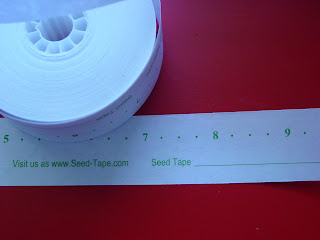
Now I have it in front of me, I can see it is just thin, bleached, white paper, I don't even think it is made of recycled paper. It probably will disintegrate fine, but is it organic enough for me?
It certainly is not as I imagined it. You have to glue each seed on to the tape. I wonder if they will stick long enough to not fall off before you get them out in the garden. I certainly don't want to use toxic glue in my organic garden. Maybe I manage to sandwich the seed between to strips of paper. I was hoping for something quick and easy, this does not look quick. At least one can make seed tapes when it is raining outside, I guess that is a bit of a time saver.
Nevertheless, even I am a bit skeptical I will try them out. There will be an update.
I don't like it when they right away charge me and then don't send it out. Hey what is with that? I like my money do interest on my account, not yours!
I ordered March 20th and it arrived just last Friday, May 1st. I was not aware that they are producing it themselves, they don't say on their website. This was their excuse, they could not produce it fast enough because of the large amount of orders.
I thought it would be just like the fleece paper seed tape I am familiar with, where you sandwich the seeds between the seed tape and it is self stick.

Now I have it in front of me, I can see it is just thin, bleached, white paper, I don't even think it is made of recycled paper. It probably will disintegrate fine, but is it organic enough for me?
It certainly is not as I imagined it. You have to glue each seed on to the tape. I wonder if they will stick long enough to not fall off before you get them out in the garden. I certainly don't want to use toxic glue in my organic garden. Maybe I manage to sandwich the seed between to strips of paper. I was hoping for something quick and easy, this does not look quick. At least one can make seed tapes when it is raining outside, I guess that is a bit of a time saver.
Nevertheless, even I am a bit skeptical I will try them out. There will be an update.
Friday, March 20, 2009
Planting with home made Seed Tape
Sometimes I have a hard time planting the tiny seeds without wasting to many seeds. It is really hard to spread the small seeds at a proper distance, often you can't even see where you put them. I hate to waste so many seeds, but even more annoying is the extra work I have, having to pull the excess seedlings to make room for the ever growing plants.
When I still lived in Germany, 25 years ago, they sold many varieties of vegetables in Seed tape. It was a fleece type paper, similar to tissue paper which easily dissolved once planted.
It was so easy to plant. You just tore the right amount off and laid it in proper distance on the bed, spread some soil on top. Done!
In my early gardening days in the US, I often looked for Seed Tape in the plant catalogs, never found it until a few years ago.
Some things just take a long time to make their entrance to the US.
We are such a progressive country, for some reason we are often behind the rest of the world in new things.
For just a few years you finally can find Seed Tapes in a few catalogs, very few catalogs that is. But they have such a small amount of seed varieties offered that it is hardly worth bothering with it. Especially for gardeners which like Heirloom Vegetables.
Luckily they are easy to make yourself. All you need is some tissue like paper. Toilet paper works well, I like to use commercial type paper towels, like they often have in restaurants bathrooms.
Then you need some glue, like Elmer's Glue or you can do what I do, just boil some Cornstarch in water until it is thick like glue, it works just as well and there are no chemicals involved.
I don't have exact measurements for it because I just mix a little Cornstarch in water, cook it and if not thick to my liking I add some more Cornstarch and repeat. Just remember not to get it too thick, because it has to be able to come out of a squeeze bottle. After it cools down a bit transfer to an old glue bottle and you are set.
To make the Seed tape, I put little dabs of the glue mix in the right distance for the seeds to grow. I seed mine a bit closer, just to make sure I have enough sprouting. Rarely all the seeds will sprout, and the few extra seedlings I just pull when needed.
 Then I put the seeds on the little daps of glue and cover the sheet with another paper towel, labeled with the varieties name, so I don't confuse the plants.
Now all you have to do let them dry, fold them up and next time you get out to the garden, lay them on the prepared garden bed, cover with a bit of soil and you are done planting.
The nice thing about it is, that when the weather is too rainy to go outside to plant, you can prepare the seed tape inside, knowing once the rain has stopped, you quickly can plant your seeds.
So after I made these seed tapes, I found this product on the web.
Make your own seed tape http://seed-tape.com/index.html, just like the Seed tape I knew in Germany. You just add your own seeds. I think I will order some of that.
Go figure, I have been looking for that for such a long time and right after I make my own, there it is.
When I still lived in Germany, 25 years ago, they sold many varieties of vegetables in Seed tape. It was a fleece type paper, similar to tissue paper which easily dissolved once planted.
It was so easy to plant. You just tore the right amount off and laid it in proper distance on the bed, spread some soil on top. Done!
In my early gardening days in the US, I often looked for Seed Tape in the plant catalogs, never found it until a few years ago.
Some things just take a long time to make their entrance to the US.
We are such a progressive country, for some reason we are often behind the rest of the world in new things.
For just a few years you finally can find Seed Tapes in a few catalogs, very few catalogs that is. But they have such a small amount of seed varieties offered that it is hardly worth bothering with it. Especially for gardeners which like Heirloom Vegetables.
Luckily they are easy to make yourself. All you need is some tissue like paper. Toilet paper works well, I like to use commercial type paper towels, like they often have in restaurants bathrooms.
Then you need some glue, like Elmer's Glue or you can do what I do, just boil some Cornstarch in water until it is thick like glue, it works just as well and there are no chemicals involved.
I don't have exact measurements for it because I just mix a little Cornstarch in water, cook it and if not thick to my liking I add some more Cornstarch and repeat. Just remember not to get it too thick, because it has to be able to come out of a squeeze bottle. After it cools down a bit transfer to an old glue bottle and you are set.

To make the Seed tape, I put little dabs of the glue mix in the right distance for the seeds to grow. I seed mine a bit closer, just to make sure I have enough sprouting. Rarely all the seeds will sprout, and the few extra seedlings I just pull when needed.
 Then I put the seeds on the little daps of glue and cover the sheet with another paper towel, labeled with the varieties name, so I don't confuse the plants.
Now all you have to do let them dry, fold them up and next time you get out to the garden, lay them on the prepared garden bed, cover with a bit of soil and you are done planting.
The nice thing about it is, that when the weather is too rainy to go outside to plant, you can prepare the seed tape inside, knowing once the rain has stopped, you quickly can plant your seeds.
So after I made these seed tapes, I found this product on the web.
Make your own seed tape http://seed-tape.com/index.html, just like the Seed tape I knew in Germany. You just add your own seeds. I think I will order some of that.
Go figure, I have been looking for that for such a long time and right after I make my own, there it is.
Saturday, February 28, 2009
What is growing in my Kitchen Garden
I used to not have anything in my Kitchen Garden over the Winter but with the years I figured out an easy way to always have at least some Greens and Lettuce for fresh eating at a time in late Winter when most people haven't even started planting their Spring Garden yet.
My Winter Garden Secret? Just let the late Summer/Fall plants bolt and the seeds fall to the ground. For me it sometimes is just more reliable then planting them at a specific time. The seeds know when it is the right time to sprout.
Naturally you don't want to do this with Hybrid Seeds. Hybrid Seeds are seeds produced by artificially cross pollinating different plant varieties to produce a new variety with specific characteristics. So when you plant their seed, they do not reliably produce true copies of the new varieties. You don't know what comes out of them.
To get true copies of the plant you have, you need Heirloom Seeds or Open Pollinated Seed.
Because most of my vegetable plants are now Heirlooms or Open pollinated seeds, I now collect seeds of many vegetables I plant. Some I don't even bother to seed out, I just let some seeds fall to the ground and let them do their own work of seeding out. It works well for me. In late fall or Spring I just dig up as many plants I want and move them to the new prepared beds.
Sometimes some plants, especially Arugula will seed way more out then I can move. I just let it grow where it is, even if it is in the walk ways and just harvest as much as I can before it bolts again. Arugula is a welcome Greens in my late Winter Garden, when there is not much else to harvest. It seems to be real hardy and grows well through the winter.
So this is what I have planted so far and what can be found in my Kitchen Garden Spring 2009 Garden Season.
Peas: They have not sprouted yet - planted mid February '09
Shelling Peas
'Kleine Rheinländerin', from Gourmet Seed International
'Eclipse' >> Johnny's Selected Seeds
'Dakota' >> Johnny's Selected Seeds
Snow Peas:
'Snow Wind' >> Johnny's Selected Seeds
'Norli' >> Shepherd's Garden Seed
Italian Arugula >> from Gourmet Seed International
This comes up real early in the season, because I just let some seed out in Fall,
I am already harvesting and eating Arugula
Machè/Cornsalad/Feldsalat >>Old Unknown German Variety
I also let this seed out late Summer, I am never without in late Winter, already harvesting
Spinach: has not sprouted yet - seeded out mid February '09
'Bloomsdale' >> Gourmet Seed International
'Oriental Giant' >> Renee's Garden Seed
Kale:
Russian Kale >> Seeds of Change
planted last Fall '08 - overwintered
Broccoli:
'Red Arrow' >> locally bought - Mr. Fothergills Seeds/UK
'White Sprouting' >> Gourmet Seeds International - Mr. Fothergills Seeds/UK
'Zamboni' >> Territorial Seed Company/local company in Cottage Grove, OR
all planted Summer '08, overwintered and are starting to grow heads
Cauliflower:
'Gigante Di Napoli Marzatico' >>Gourmet Seed International
planted in late Summer and overwintered, it is growing nicely while some of my other Cauliflower, which was a different cultivar all froze this year.
Cabbage:
'Red Cabeza' seeded in late summer '08 >> Gourmet Seed International
and 'Super Red 80 F1' two small Red Cabbages, which I harvested, but then left the root in, so it regrew two small heads. >> Johnny's Selected Seeds
'Cour Di Bue' - these ones did take a beating in this cold winter, but now seem to make some heads >> Gourmet Seed International
Endive:
'di Ruffec' and 'Bubikopf' >> Italian Seed & Tool Co
I have been letting it seed out in late Summer '08 and will be eating Endive soon
Raddichio:
'Palla Rossa 3' also from letting it seed outside. So far I only found 2 of those so I probably will seed some more out >> Gourmet Seed International
Lettuce: I have a variety of Lettuces, which I let seed out last fall. So far I see I have growing
Butterhead Lettuce 'Sandrina' >> Seeds of Change,
Leaf Lettuce 'Verde Riccciolina', Butter Head Lettuce 'Santa Anna',
Red Butter Head Lettuce 'German Brown', Crisp Head Lettuce 'Ice Queen',
Head Lettuce 'Trotzkopf' >> Italian Seed & Tool Co
Romaine type 'Cimmaron' >> locally bought 'Botanical Interest' Seed
Crisphead Lettuce >>locally bought 'Botanical Interest' Seed
Loose Leaf Head lettuce 'Red Prize'>> was a free Seedpack, 'Ferry Morse Seed' it is very similar to 'Four Seasons'
Leaf Lettuce: 'Dark Red Oak Leaf'-white Seed' >>my own Garden Seed I had for a long time
and a lighter colored variety 'Light Red Oak Leaf-white Seed' my own Garden seed
Red Loose leaf Head lettuce 'Four Seasons' >> Seeds of Change
'Green Romaine-white Seed' >> my own Garden seed, don't remember Cultivar
Butterhead Lettuce: 'Green Leaved-white Seed' >>my own Garden seed
Butterhead Lettuce: 'Green Leaved-black Seed' >>my own Garden seed
Parsley: I have different varieties
'Curly Parsley', 'Italian Flat Leaf', 'Giant Flat Leaf'
>> Originally from Territorial Seed Co
I let them seed out last fall and then moved the young plants to where I wanted them
Garlic: planted Early November '08
Elephant Garlic, Softneck 'French Tarne' , 'Siciliano' and 'Transylvanian'.
Hardneck 'Georgian Crystal', 'German Porcelain' and 'Purple Glazer'
>> The Garlic Store
Onions:
Shallots 'Dutch Yellow' and 'German Red'
>> Big John's Garden/Klamath Falls, OR
Italian Red Onion-long day type 'Cipolla Rossa Piatta D'italia'
>> Italian Seed & Tool Co
I planted those late Summer '08 and let them overwinter
Leek:
'Primor' - Baby Leek size >> Renee's Garden Seeds
and 'Sherwood Leek' a large type Leek >> Seeds of Change
from harvested Seed and planted late Summer '08 letting it overwinter
Celeriac:
Variety 'Brilliant', from harvested Seed from '08 >> Territorial Seed Co
seeded in late Summer and overwintered
I also seeded out a variety of Carrots Summer '08, but the freezing and thawing this winter pushed them out of the ground, so there will be no Carrots early this Spring.
My Winter Garden Secret? Just let the late Summer/Fall plants bolt and the seeds fall to the ground. For me it sometimes is just more reliable then planting them at a specific time. The seeds know when it is the right time to sprout.
Naturally you don't want to do this with Hybrid Seeds. Hybrid Seeds are seeds produced by artificially cross pollinating different plant varieties to produce a new variety with specific characteristics. So when you plant their seed, they do not reliably produce true copies of the new varieties. You don't know what comes out of them.
To get true copies of the plant you have, you need Heirloom Seeds or Open Pollinated Seed.
Because most of my vegetable plants are now Heirlooms or Open pollinated seeds, I now collect seeds of many vegetables I plant. Some I don't even bother to seed out, I just let some seeds fall to the ground and let them do their own work of seeding out. It works well for me. In late fall or Spring I just dig up as many plants I want and move them to the new prepared beds.
Sometimes some plants, especially Arugula will seed way more out then I can move. I just let it grow where it is, even if it is in the walk ways and just harvest as much as I can before it bolts again. Arugula is a welcome Greens in my late Winter Garden, when there is not much else to harvest. It seems to be real hardy and grows well through the winter.
So this is what I have planted so far and what can be found in my Kitchen Garden Spring 2009 Garden Season.
Peas: They have not sprouted yet - planted mid February '09
Shelling Peas
'Kleine Rheinländerin', from Gourmet Seed International
'Eclipse' >> Johnny's Selected Seeds
'Dakota' >> Johnny's Selected Seeds
Snow Peas:
'Snow Wind' >> Johnny's Selected Seeds
'Norli' >> Shepherd's Garden Seed
Italian Arugula >> from Gourmet Seed International
This comes up real early in the season, because I just let some seed out in Fall,
I am already harvesting and eating Arugula
Machè/Cornsalad/Feldsalat >>Old Unknown German Variety
I also let this seed out late Summer, I am never without in late Winter, already harvesting
Spinach: has not sprouted yet - seeded out mid February '09
'Bloomsdale' >> Gourmet Seed International
'Oriental Giant' >> Renee's Garden Seed
Kale:
Russian Kale >> Seeds of Change
planted last Fall '08 - overwintered
Broccoli:
'Red Arrow' >> locally bought - Mr. Fothergills Seeds/UK
'White Sprouting' >> Gourmet Seeds International - Mr. Fothergills Seeds/UK
'Zamboni' >> Territorial Seed Company/local company in Cottage Grove, OR
all planted Summer '08, overwintered and are starting to grow heads
Cauliflower:
'Gigante Di Napoli Marzatico' >>Gourmet Seed International
planted in late Summer and overwintered, it is growing nicely while some of my other Cauliflower, which was a different cultivar all froze this year.
Cabbage:
'Red Cabeza' seeded in late summer '08 >> Gourmet Seed International
and 'Super Red 80 F1' two small Red Cabbages, which I harvested, but then left the root in, so it regrew two small heads. >> Johnny's Selected Seeds
'Cour Di Bue' - these ones did take a beating in this cold winter, but now seem to make some heads >> Gourmet Seed International
Endive:
'di Ruffec' and 'Bubikopf' >> Italian Seed & Tool Co
I have been letting it seed out in late Summer '08 and will be eating Endive soon
Raddichio:
'Palla Rossa 3' also from letting it seed outside. So far I only found 2 of those so I probably will seed some more out >> Gourmet Seed International
Lettuce: I have a variety of Lettuces, which I let seed out last fall. So far I see I have growing
Butterhead Lettuce 'Sandrina' >> Seeds of Change,
Leaf Lettuce 'Verde Riccciolina', Butter Head Lettuce 'Santa Anna',
Red Butter Head Lettuce 'German Brown', Crisp Head Lettuce 'Ice Queen',
Head Lettuce 'Trotzkopf' >> Italian Seed & Tool Co
Romaine type 'Cimmaron' >> locally bought 'Botanical Interest' Seed
Crisphead Lettuce >>locally bought 'Botanical Interest' Seed
Loose Leaf Head lettuce 'Red Prize'>> was a free Seedpack, 'Ferry Morse Seed' it is very similar to 'Four Seasons'
Leaf Lettuce: 'Dark Red Oak Leaf'-white Seed' >>my own Garden Seed I had for a long time
and a lighter colored variety 'Light Red Oak Leaf-white Seed' my own Garden seed
Red Loose leaf Head lettuce 'Four Seasons' >> Seeds of Change
'Green Romaine-white Seed' >> my own Garden seed, don't remember Cultivar
Butterhead Lettuce: 'Green Leaved-white Seed' >>my own Garden seed
Butterhead Lettuce: 'Green Leaved-black Seed' >>my own Garden seed
Parsley: I have different varieties
'Curly Parsley', 'Italian Flat Leaf', 'Giant Flat Leaf'
>> Originally from Territorial Seed Co
I let them seed out last fall and then moved the young plants to where I wanted them
Garlic: planted Early November '08
Elephant Garlic, Softneck 'French Tarne' , 'Siciliano' and 'Transylvanian'.
Hardneck 'Georgian Crystal', 'German Porcelain' and 'Purple Glazer'
>> The Garlic Store
Onions:
Shallots 'Dutch Yellow' and 'German Red'
>> Big John's Garden/Klamath Falls, OR
Italian Red Onion-long day type 'Cipolla Rossa Piatta D'italia'
>> Italian Seed & Tool Co
I planted those late Summer '08 and let them overwinter
Leek:
'Primor' - Baby Leek size >> Renee's Garden Seeds
and 'Sherwood Leek' a large type Leek >> Seeds of Change
from harvested Seed and planted late Summer '08 letting it overwinter
Celeriac:
Variety 'Brilliant', from harvested Seed from '08 >> Territorial Seed Co
seeded in late Summer and overwintered
I also seeded out a variety of Carrots Summer '08, but the freezing and thawing this winter pushed them out of the ground, so there will be no Carrots early this Spring.
Wednesday, February 25, 2009
Seed growing
I finally found time to start some seeds.
Usually I start all my seeds in my small sun room adjacent to my living room with mixed results. The sun room is not heated and is built with old, drafty, big, single pane, sliding doors, which lets all the cold air in. It can get very cold in there, I measured temperatures in the upper mid 30s F in there when it is freezing outside. Not exactly the best seed starting environment.
In fact the first year I moved in this house I was so overjoyed of finally having a sun room that I went out and bought a lot of houseplants, put them in the sun room, which then all expired over the first winter because of the cold. Eventually I hope to remodel this room to make it more useful.
The coolness in this room is not so much a problem at this time of the year for starting some lettuce and other cool season crops, but forget about Tomatoes and Peppers. So I usually had to wait until it warmed up outside before I could even think of trying to start these warm season plants. This meant not until late March to May. Even then the room was too cool for them to grow well, the seeds taking a long time to sprout and then growing slowly. Tomatoes usually did better, but for Peppers and Eggplants it is important to have a warm growing condition, they experience a big set back in growing, which will hinder fruit development for the rest of the season, they just don't produce well with such a bad start at life.

So this year I decided to start the plants on my sowing table in my office. They do not get as much light as in the sun room, but I used the upper part of my homemade PVC-Pipe growing shelf in the sun room, hooked up some florescent lighting above and hopefully they will grow better then the last years.
In the last years I used a seed starting system called 'APS' which stands for 'Accelerated Propagation System' I got at 'Gardeners Supply Company' . They are Styrofoam seedling trays, which sit on top of an Styrofoam insert, between them a capillary mat, all sitting inside a plastic reservoir with a clear cover on top. The capillary fleece mat between wicks moisture from the reservoir to feed just the right amount of water to the growing medium and come in different sizes.
Instead I decided to use my dear old 'Newspaper pot maker' again
and a new growing system, I found at 'Jung Seed' made in Sweden by 'Agralan' called 'Compact Plant Trainer System'.
 It looks real sturdy and they say you can wash the trays in the dishwasher.
It is not that the APS system did not work well. It did provide a good growing environment for the seedlings, but I did not like that it is made with Styrofoam, a material which is pretty low on the list of environmental good materials, but it also was hard to clean without breaking the material and the plastic parts were a bit flimsy and I knew I would soon have to replace them.
So in my opinion not very sustainable.
The Plant trainer has 49 spaces for small plug trained plants, so I will have to transplant them to larger pots at some point, but it also is self watering, has the same features then the 'APS' system, but sturdier. They really look like they will last many years, which again fits in my viewpoint of trying to be more sustainable.
I filled the seedlings trays with one of the Seedling dirt mixes from the Lane County 'Master Gardener Association' using Coconut Fibers, Garden Compost, Vermiculite, Perlite and Sand and will see how well my plants will grow in this mixture.
Usually I start all my seeds in my small sun room adjacent to my living room with mixed results. The sun room is not heated and is built with old, drafty, big, single pane, sliding doors, which lets all the cold air in. It can get very cold in there, I measured temperatures in the upper mid 30s F in there when it is freezing outside. Not exactly the best seed starting environment.
In fact the first year I moved in this house I was so overjoyed of finally having a sun room that I went out and bought a lot of houseplants, put them in the sun room, which then all expired over the first winter because of the cold. Eventually I hope to remodel this room to make it more useful.
The coolness in this room is not so much a problem at this time of the year for starting some lettuce and other cool season crops, but forget about Tomatoes and Peppers. So I usually had to wait until it warmed up outside before I could even think of trying to start these warm season plants. This meant not until late March to May. Even then the room was too cool for them to grow well, the seeds taking a long time to sprout and then growing slowly. Tomatoes usually did better, but for Peppers and Eggplants it is important to have a warm growing condition, they experience a big set back in growing, which will hinder fruit development for the rest of the season, they just don't produce well with such a bad start at life.

So this year I decided to start the plants on my sowing table in my office. They do not get as much light as in the sun room, but I used the upper part of my homemade PVC-Pipe growing shelf in the sun room, hooked up some florescent lighting above and hopefully they will grow better then the last years.
In the last years I used a seed starting system called 'APS' which stands for 'Accelerated Propagation System' I got at 'Gardeners Supply Company' . They are Styrofoam seedling trays, which sit on top of an Styrofoam insert, between them a capillary mat, all sitting inside a plastic reservoir with a clear cover on top. The capillary fleece mat between wicks moisture from the reservoir to feed just the right amount of water to the growing medium and come in different sizes.
Instead I decided to use my dear old 'Newspaper pot maker' again

and a new growing system, I found at 'Jung Seed' made in Sweden by 'Agralan' called 'Compact Plant Trainer System'.
 It looks real sturdy and they say you can wash the trays in the dishwasher.
It is not that the APS system did not work well. It did provide a good growing environment for the seedlings, but I did not like that it is made with Styrofoam, a material which is pretty low on the list of environmental good materials, but it also was hard to clean without breaking the material and the plastic parts were a bit flimsy and I knew I would soon have to replace them.
So in my opinion not very sustainable.
The Plant trainer has 49 spaces for small plug trained plants, so I will have to transplant them to larger pots at some point, but it also is self watering, has the same features then the 'APS' system, but sturdier. They really look like they will last many years, which again fits in my viewpoint of trying to be more sustainable.
I filled the seedlings trays with one of the Seedling dirt mixes from the Lane County 'Master Gardener Association' using Coconut Fibers, Garden Compost, Vermiculite, Perlite and Sand and will see how well my plants will grow in this mixture.
Friday, February 13, 2009
Tools to grow your seeds
I just found a neat, low tech tool for figuring out when you need to start your seeds indoor or outdoor and when to plant them in your garden.
All you need to know is when your last and first frost is in your growing area, a printer and some printer paper. It is like a little booklet you print out and then you add your frost dates and then you fold it and staple it together. Voila! you are done.
It has a place for adding your notes, or you could add more vegetable names.
It is so nice, there are so many resources for the gardener on the web. Gardeners are very resourceful kind of people, very inventive and just as they like to share their plants, they like to share what they come up with. Thank you Ivory for sharing this neat tool.
All you need to know is when your last and first frost is in your growing area, a printer and some printer paper. It is like a little booklet you print out and then you add your frost dates and then you fold it and staple it together. Voila! you are done.
It has a place for adding your notes, or you could add more vegetable names.
It is so nice, there are so many resources for the gardener on the web. Gardeners are very resourceful kind of people, very inventive and just as they like to share their plants, they like to share what they come up with. Thank you Ivory for sharing this neat tool.
Wednesday, February 11, 2009
Getting Ready Or Not
I am getting ready to start my new kitchen garden for this year. Or am I?
In this region, you must take your chance to go out, when it comes. The chance is, when the rain stops.
Last week I got out, it was a nice, rare sunny Oregon winter day. I was able to fill up some of my garden beds with some home made compost and some mint compost from Lane Forest Product, which is one of our local yard waste and wood recyclers. They sell all kinds of garden dirt and compost. Mint compost I have been told is a great supplement for tired and hard soil. I never heard of Mint compost before I moved here. Oregon used to have a lot of Mint farms, for Mint oil production, it leaves over a lot of waste material. Anyway I tried it last year and it seemed to do a good job. My dirt is looking better already. I am not making enough compost to fill these new garden beds so I am glad there are many places in town to get compost.
I just started last year converting some of my beds into raised Beds. Before, I just heaped the soil up into rectangular beds. There nothing was holding up the soil, eventually it all slipped into the walk ways, the neighbors cats, didn't help the matter either. They like to dig in my garden beds to do their business in it. I don't like the cats.
I didn't like how the weeds kept blowing into the beds from the walk way, it was hard to keep up with weeding. So I found these garden beds made in England at Gardener Supply Co, they are made of recycled plastic, you stick them together and they are affordable. They work and so far I am happy with them. Last year I did not have enough dirt to fill them. So I had to finish filling them up this year.
I also got a few more of the slim ones, for my Raspberries. I didn't like how the Raspberries constantly spread all over in the corner of the vegetable garden. They are shallow rooted and the boxes are 10" high. I put one of these fabrics for putting under mulch on the bottom, wrapping it in the inside of the box, then filled it up with my dirt mix and replanted them. I hope it works.
I like to garden, but I don't like unnecessary work. Anything I can do to reduce unnecessary work is good.

This week I was planning to put some of my seeds in the ground and in pots. But first I wanted to put all my seed information, when to plant what, according to the last Frost Date for our region into my
Garden Database software I have on my computer. Let me tell you, there is a lot of conflicting information about when the last and first frost is supposed to be. How is a Transplanted Gardener to know when to start what? Some claim the first frost to be May 21. others April 24., which is almost a month apart. I have been in this area only for 6 years, I have not yet seen any frost past April, so I chose the April date.
The week is not over yet, but so far I have not been able to get one seed into a pot. Instead I spent too much time, finding and sorting information on my computer and ordering new seeds.
Never mind I got some nice seeds, they were all open pollinated mostly Heirlooms. Open pollinated seeds fit more into my picture of trying to be a Self sustainable gardener. Luckily for me there are more and more companies selling Open-pollinated and Heirloom Vegetable Seeds. There are so many online companies, it took me a long time to make up my orders. I have more seeds of varieties then I need or could grow in one season. I am all for variety, trying new things.
To me gardening is all about the adventure, doing things differently, experiencing new things and constantly learning something new. And having fun doing it.
If I just could get organized and get them started.
In this region, you must take your chance to go out, when it comes. The chance is, when the rain stops.
Last week I got out, it was a nice, rare sunny Oregon winter day. I was able to fill up some of my garden beds with some home made compost and some mint compost from Lane Forest Product, which is one of our local yard waste and wood recyclers. They sell all kinds of garden dirt and compost. Mint compost I have been told is a great supplement for tired and hard soil. I never heard of Mint compost before I moved here. Oregon used to have a lot of Mint farms, for Mint oil production, it leaves over a lot of waste material. Anyway I tried it last year and it seemed to do a good job. My dirt is looking better already. I am not making enough compost to fill these new garden beds so I am glad there are many places in town to get compost.
I just started last year converting some of my beds into raised Beds. Before, I just heaped the soil up into rectangular beds. There nothing was holding up the soil, eventually it all slipped into the walk ways, the neighbors cats, didn't help the matter either. They like to dig in my garden beds to do their business in it. I don't like the cats.

I didn't like how the weeds kept blowing into the beds from the walk way, it was hard to keep up with weeding. So I found these garden beds made in England at Gardener Supply Co, they are made of recycled plastic, you stick them together and they are affordable. They work and so far I am happy with them. Last year I did not have enough dirt to fill them. So I had to finish filling them up this year.
I also got a few more of the slim ones, for my Raspberries. I didn't like how the Raspberries constantly spread all over in the corner of the vegetable garden. They are shallow rooted and the boxes are 10" high. I put one of these fabrics for putting under mulch on the bottom, wrapping it in the inside of the box, then filled it up with my dirt mix and replanted them. I hope it works.
I like to garden, but I don't like unnecessary work. Anything I can do to reduce unnecessary work is good.

This week I was planning to put some of my seeds in the ground and in pots. But first I wanted to put all my seed information, when to plant what, according to the last Frost Date for our region into my
Garden Database software I have on my computer. Let me tell you, there is a lot of conflicting information about when the last and first frost is supposed to be. How is a Transplanted Gardener to know when to start what? Some claim the first frost to be May 21. others April 24., which is almost a month apart. I have been in this area only for 6 years, I have not yet seen any frost past April, so I chose the April date.
The week is not over yet, but so far I have not been able to get one seed into a pot. Instead I spent too much time, finding and sorting information on my computer and ordering new seeds.
Never mind I got some nice seeds, they were all open pollinated mostly Heirlooms. Open pollinated seeds fit more into my picture of trying to be a Self sustainable gardener. Luckily for me there are more and more companies selling Open-pollinated and Heirloom Vegetable Seeds. There are so many online companies, it took me a long time to make up my orders. I have more seeds of varieties then I need or could grow in one season. I am all for variety, trying new things.
To me gardening is all about the adventure, doing things differently, experiencing new things and constantly learning something new. And having fun doing it.
If I just could get organized and get them started.
Subscribe to:
Posts (Atom)